Sam: The Secret Sauce
The sustained creation of value from data is a deceptively difficult task. The core challenge is an objective - or at least practical - method for determining how much value has been created.
Markets solve this problem for most goods, but have historically failed to operate efficiently when dealing with data. To mediate value efficiently, marketplaces must exhibit low information asymmetry, low search costs and ideally, host multiple buyers and sellers who compete for both provision and consumption of differentiated goods. As explained above, Sam has been engineered to resolve these problems structurally.
However, value creation is only half the challenge. A sustainable data sharing platform must do more than permit members to create value; it must enable members to determine if their next action increases the value created or decreases the value created. Only then can individuals both create and manage data-based prosperity. In terms of Figure 3 and 4, how ought a member behave if they desire to move towards a higher point on their personal value creation curve? Should they share more, or less data? What type of data should they share?
This is where Sam has an unfair advantage.
The value optimisation rules that guide Sam are built on currently unpublished theoretical economics and data science frameworks. Working within their framework, Sam is able to adjust the price structure of markets and nudge members to maximise the value created from data.
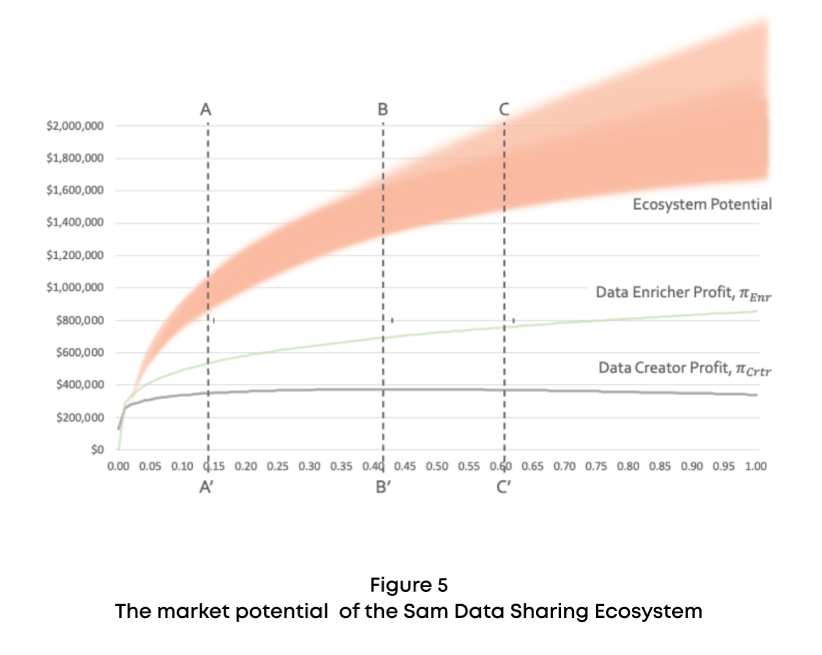
Sam's value optimisation algorithms are built around a mathematical model of interconnected markets that facilitate buyers and sellers trading in variable quantities of data and variable types of data. At the core, each member's choice lies on a continuum: keep all data private and commercialise lower performing assets, through to: share all data, maximise the utility of their assets but relinquish the privacy surrounding the data. The equations that support Sam's value optimisation algorithms broaden this multi-dimensional optimisation matrix to include data that decays at different rates and different participation intervals. Figure 5 illustrates the conservative ecosystem value of getting that organically-generated value creation process right. Even an unrealistically conservative approach - such as when Damodaran famously undervalued Uber (Damodaran, 2014) - sees the value of Sam quickly compounding.
On Sam, members create value from their data, and set the terms that govern how they plan to continue creating value. The Sam data sharing ecosystem wins when members win. Without members, Sam is just trade secrets, clever research, and massive, untapped potential.
With them, Sam is the shape of a new data-driven economy - safe in the hands of its members.