Sam + me: cutting edge research to scale your value sustainably
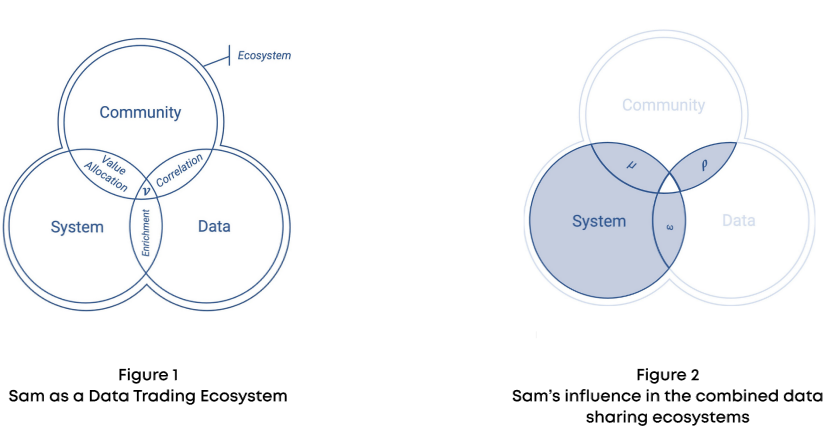
Sam is a data sharing ecosystem. A data sharing ecosystem is an organisation that operates a platform business model surrounded by a broader economy of value exchange. As I established in a recent peer-reviewed article, data sharing platforms are "a community of stakeholders who share a common, data-related goal; data collected from, and for, the community; and a system that uses the data to enable and incentivise stakeholders to make valuable interactions" (Wysel, Baker, & Billingsley, 2021). The composition of platforms and their interplay with their surrounding ecosystem is illustrated in Figure 1. Platforms create value from data when the system enriches the data in accordance with the goals of the community (Baker et al., 2021). If data sharing platforms are successful, then the community of data creators are partners with the system in value co-creation (Wysel, 2019).
While platforms do not rely on the internal control of assets in the same way 'pipeline' businesses do, they must maintain control over the means by which their members exchange value (Van Alstyne, Parker, & Choudary, 2016). If drivers and riders could meet apart from their ride sharing app then - for better and worse - the value of the app would disappear along with the value of its infrastructure (Parker, Van Alstyne, & Choudary, 2016). If platforms can retain sufficient control over those crucial exchanges, then from Metcalfe's Law, their value scales as a square of the size of their community (Evans & Schmalensee, 2016).
Sam hosts two data sharing platforms, each united by their community of data creators. Sam is able to manage this co-co-creation of value as it controls the system, terms and conditions, community rules and business processes (Figure 2) for both platforms. The common thread that holds both platforms together is that all members unite around the common goal of creating value from data (Wysel, Baker, & Conway, 2019).
In the first platform, Sam brings together users looking for private data storage with providers whose interests are aligned with their clients - and not with their other entities. Data banks differentiate themselves by providing data storage services that are required by Sam's members. However, for value to be created from data, data must also be shared. Crucially for the operation of Sam, while access to data is rivalrous, data as an economic good is non-rivalrous. For example, "a person's location history, medical records, and driving data can be used by many firms simultaneously. Nonrivalry leads to increasing returns. As a result, there may be social gains to data being used broadly across firms" (Jones & Tonetti, 2020).
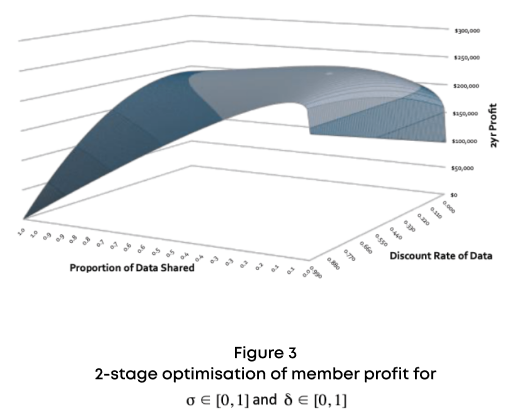
In emerging research, I show the proportion of data shared and the terms that govern the sharing agreement are two essential drivers in the creation of value from data. As illustrated in Figure 3, I prove there is an ideal point for both variables where the member can maximise the value of their data for any given data sharing ecosystem. However, members will only participate if their benefits outweigh their costs. The AI-engine built into Sam makes it possible for both sides to connect by reducing the direct and indirect cost of managing access to data for members to a level that is beneath the marginal benefit of sharing that data (Wysel, 2021). Sam allows members to create value by sharing access to data provided that access is both governed by the data banks and easily controlled by Sam.
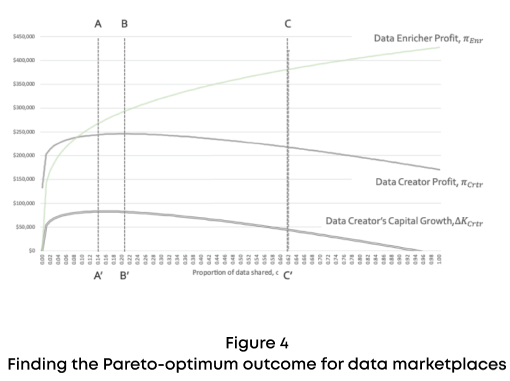
The second data sharing platform hosted by Sam is between data creators and data enrichers. As before, this platform is a multi-sided marketplace brokered by Sam. Sam's AI-engine provides member-defined access to data streams that are of interest to data enrichers. Members can be both creators and consumers of data products. Sam might prompt a member to share the data stream from her connected car while passing a section of road due for upgrade. Sam enables the same member to benefit from another's data to avoid poorly maintained or congested roads. A jogger puts a garbage bin away for another member whose health data revealed they were suffering from a winter flu. As illustrated in Figure 4, my research predicts the range where data creators will have exceeded the optimum conditions for value creation but additional sharing would enable data enrichers to continue creating additional value - albeit value captured by the data enricher. When operating in this range, Sam can automatically change the pricing structure across the data market to find the Pareto-optimum outcome for each exchange in the ecosystem. Sam enables data enrichers to begin subsidising data creators so everyone continues to benefit fairly and the platform continues to grow in value.
Up until this point, we have only been considering the hypothetical case of one data creator working with one data enricher. However, as established above, data is non-rivalrous. One data creator can simultaneously share the same data with three data enrichers and simultaneously create the same value from each partnership as each might have created in isolation. The non-rivalry of data liberates it from the 'resource congestion' that accompanies normal goods. This is the power of value creation in an economy that is predicated on access to data rather than data ownership. Indeed the non-rivalrous nature of data requires an absence of sharing for 'data ownership' models as exclusion to data is the only control mechanism against hyper-inflation. With Sam, data access permits all members to act as data enrichers, safe in the knowledge their participation, however rudimentary, does not exclude others from creating value from the same data. With Sam, the growth in value co-creation is exponential.
The 'chicken and the egg' problem is an issue that all platforms must address at creation, and during their operation. Data creators will participate when they have data enrichers to co-create with. But without data creators already participating, data enrichers can't participate. Sam has resolved this problem by building an interconnected array of five IoT networks that will offer 'launch-day' value to early adopters and investors. These verticals are: utilities management, plant machinery hire, insurance, livestock, and agribusiness management. Each vertical represents a key deployment of existing patents and licensing of trade secrets and enablement of complementary capabilities.